Trimming Dog Nails: Finding the Quick, and What to Do If You Hit It
Overlong nails change how a dog stands. Here is where the quick is, how to see it on a black nail, and the recession schedule that makes it retreat.
By Marin Okafor, editor, dog gear and nutrition labels
Published Apr 29, 2026 · 10 min read
- Grooming
In this guide
Nail length is the most consistently neglected part of dog care, and it is not cosmetic. A nail long enough to contact the ground when the dog is standing pushes the toe backward on every step. That changes the angle of the digit, shifts weight off the pads and onto the joints, and over months alters the dog's whole standing posture. In an older dog it compounds with arthritis, and in any dog on a smooth floor it costs traction.
The rule of thumb is audible. If you can hear the nails clicking on a hard floor when the dog walks, they are too long.
The reason they stay too long is the quick, and specifically the fear of it. That fear is reasonable, because cutting into the quick hurts and bleeds. It is also solvable.
What the quick is and where it sits
Inside every nail is a core of soft tissue carrying a blood supply and nerves. That is the quick. It grows forward as the nail grows, and it recedes when the nail is kept short, which is the single most important fact in this whole subject.
A dog whose nails have been long for a year has a long quick. You cannot cut those nails to the correct length in one session, no matter how careful you are, because the quick is already out at the length you want to cut to. Trying is how people end up with a bleeding dog and a dog that will never let its feet be touched again.
What you can do is take a small amount off frequently. The quick retreats behind the shortening nail over weeks. Cut a little every four or five days and the quick follows, and after six to eight weeks you can reach a length that was impossible at the start. That schedule, rather than any tool, is what fixes overgrown nails.
Seeing the quick, including on black nails
On a pale nail the quick is visible as a pink core running down the centre. Cut in front of it, leaving a couple of millimetres of clear nail. This is the easy case and it is worth using a pale-nailed dog, if you have one, to calibrate what the cut surface looks like.
On a black nail you cannot see the quick from outside, and this is where most people stop. The method is to read the cut surface instead of guessing at the outside.
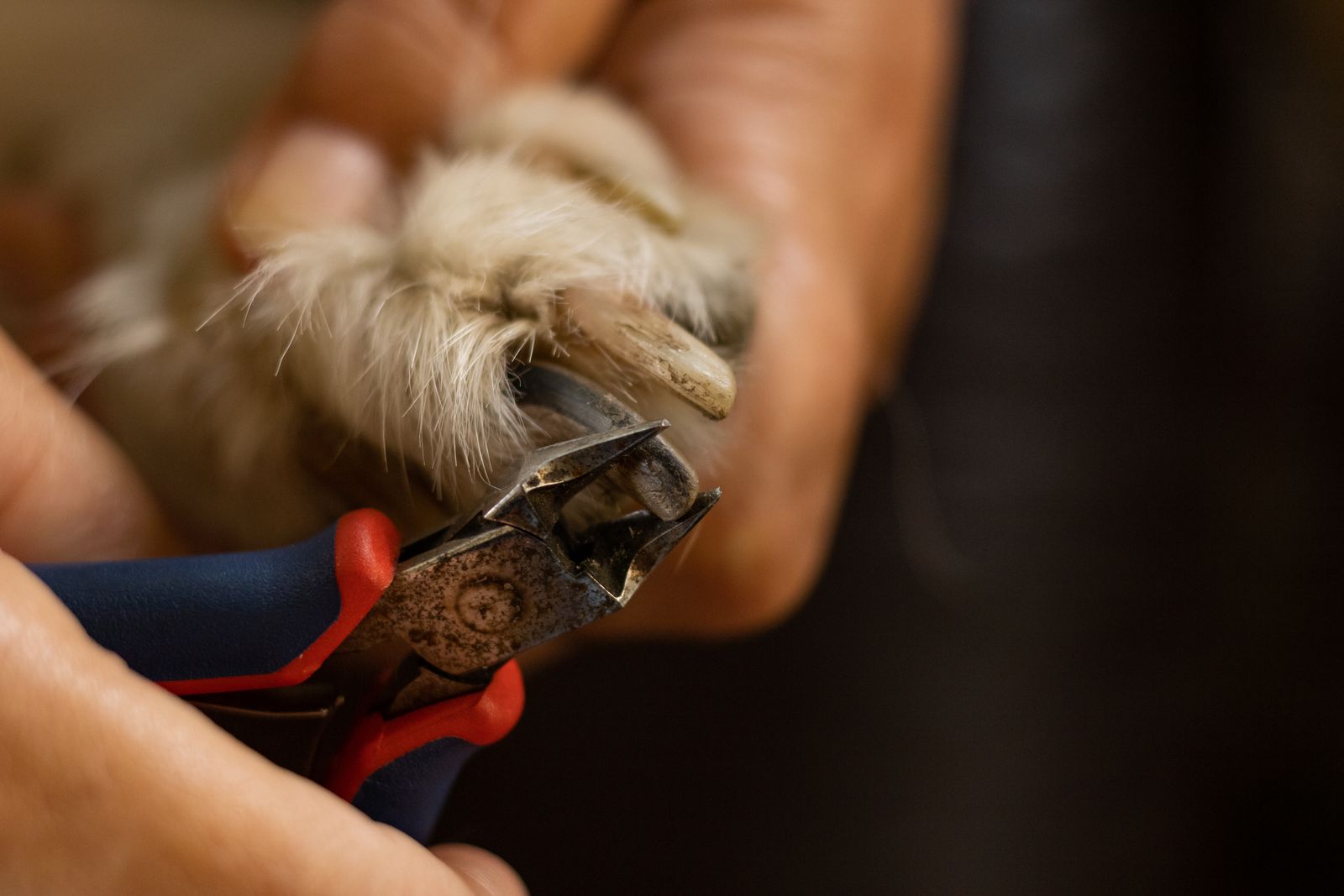
Take off a very small slice, perpendicular to the nail, and look at the freshly cut end. Early cuts show a dry, chalky, flaky white or grey surface. As you approach the quick, the centre of the cut face develops a small dark spot, sometimes described as a grey or black dot, in the middle of an otherwise pale ring. That dot is the leading edge of the quick, and it is the signal to stop. Cut once more and you are in it.
Work in thin slices and check the face after every one. It is slower than one confident cut and it is the reason people who do this successfully never draw blood.
The other landmark is the underside. Looking at the nail from below, there is a point where the nail stops being a solid tube and becomes a thinner shell that curves away. Cutting at roughly that transition is usually safe.
Clippers, grinders and which to use
Scissor-style clippers are the sensible default for most dogs. They give control, they cut cleanly, and the two blades meeting from either side avoid the crushing action of the alternative. Keep them sharp. A blunt clipper crushes the nail before it cuts, which hurts and is a common reason a dog decides it hates this.
Guillotine clippers work well on small and medium nails and struggle on thick ones. The blade is replaceable and needs replacing more often than people do it.
Grinders take the nail down with a rotating abrasive drum. They are excellent for the nervous case, because they remove material gradually and it is very difficult to take too much in one moment. They also let you round the edge, which matters if the dog sits on your lap. The costs are noise, vibration and heat: introduce one slowly over days, and work in short bursts so the nail does not get hot.
Whichever you use, have styptic powder open and within reach before you start. Not in a drawer. Open, on the table.
If you hit the quick
It happens, including to people who have done this for years. What matters is what you do in the next thirty seconds.
Press styptic powder firmly onto the nail end and hold it there with steady pressure for a good thirty seconds without lifting to check. Lifting to check is what makes it keep bleeding. Cornflour or plain flour will do at a push, packed on the same way, and a bar of unscented soap pressed against the nail works too.
Then stop for the day. Not because the dog is injured, since a quicked nail is painful and minor rather than dangerous, but because continuing teaches the dog that the pain was the start of a long session rather than the end of one. Give a treat, release the foot, and come back tomorrow.
If bleeding has not stopped after ten minutes of pressure, phone your vet. That is uncommon and worth taking seriously, particularly in a dog on any medication affecting clotting.
Building a dog that tolerates it
Most adult dogs that hate nail trims learned to, usually in one bad session. Rebuilding is slower than building it in the first place and it works the same way.
Start with the foot, not the clippers. Touch a paw, treat, release. Do that until it is boring. Then hold the paw, treat, release. Then separate a toe. Then touch the clipper to the nail without cutting, treat, release. Then one nail, treat, and stop for the day. One nail a day is a complete session and is faster in the end than one fight a month.
Position matters more than people expect. Many dogs object to being loomed over and rolled onto their back, and are far calmer standing, or lying on their side, with the person beside rather than above them. A lick mat with something spreadable on it, held by a second person or stuck to a wall, converts the whole exercise for a lot of dogs.
Never end a session on a struggle. Ending on a struggle is what trains the struggle.
Dewclaws and the schedule
Dewclaws sit higher on the leg and never touch the ground, which means they never wear and are the nail most likely to be forgotten. An unchecked dewclaw can grow round in a circle and back into the pad, which is painful and needs a vet. Check them every time.
For frequency: every two to four weeks for most dogs, weekly on the short recession schedule if you are bringing overgrown nails back. Dogs walked mostly on pavement wear the front nails and often need less. Dogs walked on grass need more. Every dog needs its dewclaws done regardless.
Why this is worth the trouble
Short nails let the toes sit correctly, keep the weight on the pads where it belongs, and preserve traction on hard floors. In an older dog that traction is the difference between confidence and a slip, and slipping on smooth flooring is a genuine contributor to injury and to the reluctance to move that owners read as ageing.
It also compounds with everything else. A dog with well-managed feet is a dog whose feet get handled regularly, which means mats between the pads, cracked pads, grass seeds and lumps get found early. The same argument runs through coat management and through what to do when a coat starts to mat: the tool matters less than the frequency, and the frequency is what makes the animal tolerate it. The grooming kit worth owning is short and the clippers belong in it.
Questions people actually ask
How often should I trim my dog's nails?
Every two to four weeks for most dogs, and weekly if you are bringing overgrown nails back so the quick recedes. The audible test is the practical one: if you can hear clicking on a hard floor, they are too long. Dewclaws need doing on the same schedule regardless of surface.
How do I cut black nails without hitting the quick?
Read the cut face rather than the outside. Take thin slices and look at the freshly cut end after each one. A chalky pale surface means keep going. A small dark dot appearing in the centre of the pale face means the quick is right behind it, and that is the stopping point.
What do I do if the nail bleeds?
Press styptic powder onto the nail end and hold steady pressure for thirty seconds without lifting to check. Cornflour or a bar of soap will substitute. Then stop for the day. Call your vet if it has not stopped after ten minutes of pressure.
Are grinders better than clippers?
For nervous dogs and for black nails, often yes, because they remove material gradually and rounding the edge is easy. The trade-offs are noise, vibration and heat, so introduce one over several days and work in short bursts.
My dog will not let me near its feet. What now?
Rebuild from touching the paw, one step at a time over days, ending every session before the dog objects. One nail a day counts as a session. If the reaction is severe, talk to your vet about sedation for the trim rather than forcing it, because one bad session sets you back months.
Sources
As an Amazon Associate we earn from qualifying purchases. We earn a commission on some links, at no extra cost to you. It never changes which products we recommend or the order they appear in. Full disclosure

Who wrote this
Marin Okafor
Editor, dog gear and nutrition labels
Marin Okafor edits PetGearSearch and writes the dog side of it: food, beds, crates, carriers, grooming tools, and the pet insurance policies that pay for the rest. The ingredient panel and the AAFCO statement get read before a single review does, because that back-of-bag paragraph is where two apparently identical foods stop being identical.
The standard
How this guide was built
- The full product specification, ingredient panel or material spec, read end to end rather than summarised from a retail listing.
- The veterinary and regulatory guidance that applies to the category, cited by name and linked — AAFCO nutrient profiles, WSAVA manufacturer guidelines, the VOHC accepted-product list.
- Aggregated owner reviews at volume across retailers, read for the pattern rather than the anecdote, with deliberate attention to the one-star reports where the failure modes live.
- Every price checked against the live listing on the date printed beside it.