Best Cat Toys for Mind and Play
Five cat toys that hold a cat's interest past week one, chosen around prey sequence, solo play and the failure modes that make most toys landfill.
By Tess Lindqvist, writer, cat products and everyday health
Published Aug 11, 2026 · 10 min read
- Toys & Play
- 5 products compared
In this guide
Almost every cat toy sold works for about four days. The cat is interested, then it is not, and the toy joins the pile under the sofa with the others. Owners read that as the cat being fussy. It is closer to the opposite: the toy failed to complete the sequence a cat is wired to run, and an unfinished sequence is unsatisfying in a way a cat has no way to tell you about.
That sequence is stare, stalk, chase, pounce, kill, eat. A laser dot delivers the first four brilliantly and then evaporates, which is why so many cats get frantic with a laser and then go and bite something. A catnip mouse delivers the last two and none of the first four. The toys that survive in a house for years are the ones that either complete the sequence or let the cat complete it against something physical, and the toys that need a human hand are usually the better ones for exactly that reason.
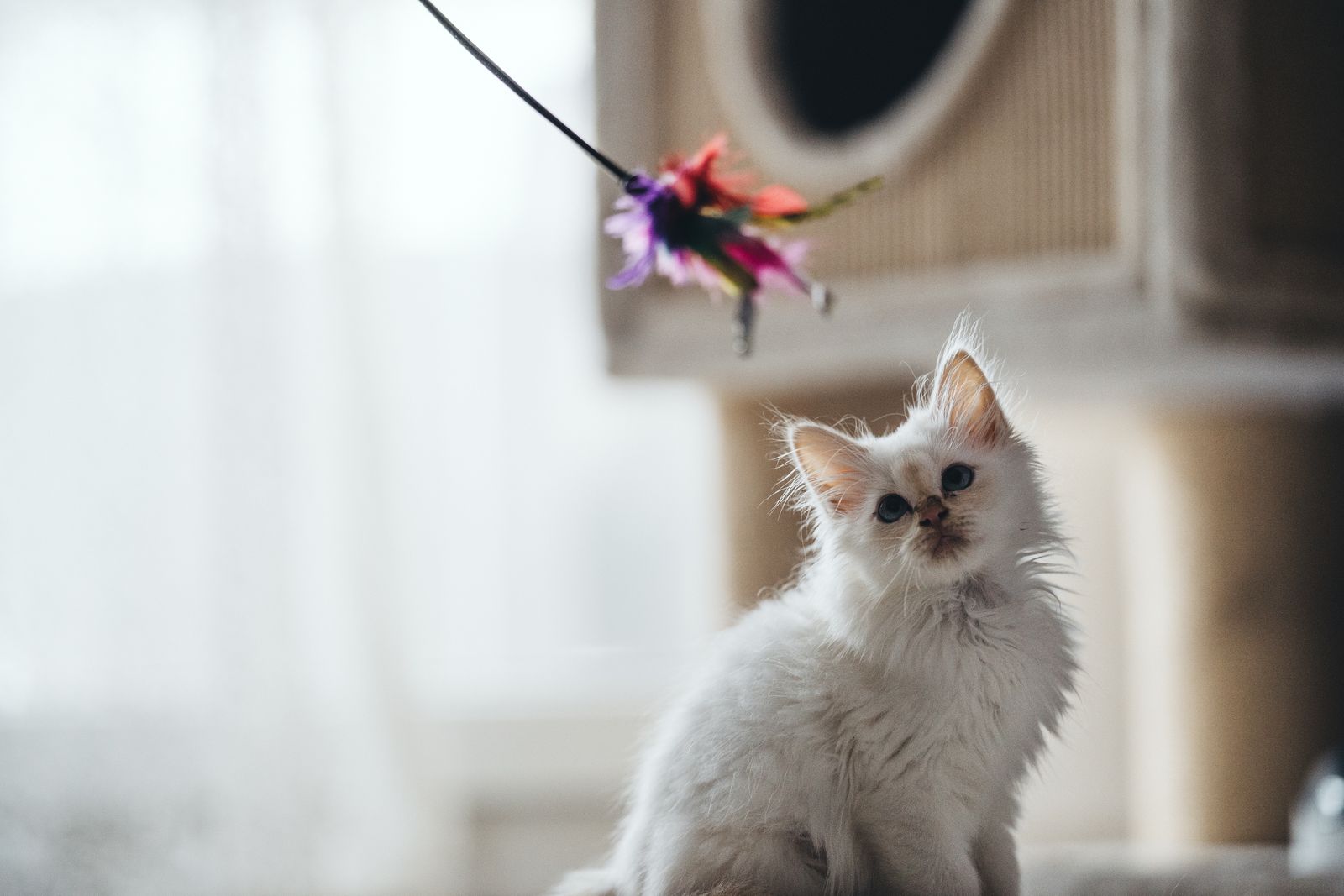
These five cover the range: two you operate, three the cat can use alone at three in the morning without waking you. Food puzzles belong in the same category and are covered separately. Between them they solve the problem that indoor cats actually have, which is not a shortage of objects but a shortage of things to hunt. The other half of that problem is vertical, and where a cat tree stands decides whether it helps.
What separates a toy that lasts from a toy that does not
Movement has to be prey-like, not random. Prey moves away from the cat, pauses, changes direction, and hides. It does not fly directly at the cat's face. This is why a wand in a skilled hand outperforms every battery-powered toy ever made, and why the automatic toys that do work are the ones that stop unpredictably.
The cat has to be able to win. End every wand session by letting the cat catch and hold the target, then follow it with food if you can. A hunt that never concludes builds frustration rather than discharging it.
Solo toys have to be safe unattended. That means no string, no elastic, no small detachable parts, and no feathers left out overnight. String and tinsel are a genuine surgical emergency in cats, because the barbs on the tongue make it impossible to spit out, and a linear foreign body in the intestine is far worse than a swallowed object that stays put.
Rotation beats accumulation. Four toys in circulation and eight in a cupboard, swapped weekly, produces more play than twelve toys permanently on the floor. Novelty is most of what you are buying.
The picks

$10.95
Price checked Aug 11, 2026
Go Cat Da Bird Feather Wand
The wand toy that cat behaviourists keep recommending, because the feather assembly spins on its swivel as it moves and produces something genuinely close to the flight of a real bird. Cats that ignore every other toy in the house will work for this one.
We may earn a commission on this link. It never changes the ranking.
- Type
- Interactive wand
- Length
- 36 inch pole
- Refills
- Replaceable feather attachments
- Supervision
- Required, string is not a solo toy
What works
- The spinning feather motion triggers a chase response in cats that ignore other wands
- Refills are sold separately, so the pole lasts for years
- Handcrafted and consistently well reviewed for durability
- Gives the human a role, which is most of the point
What to know
- Must be put away between sessions because of the string
- Feathers are consumable and a determined cat destroys them
- Requires you to actually play, so it does nothing on its own
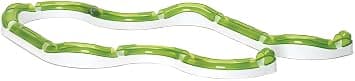
Catit Senses 2.0 Super Circuit
The best-designed closed-track ball toy on the market, and the one solo toy we recommend without reservation. The ball cannot be batted under the fridge, which is the failure mode that ends every loose-ball toy, and the track is reconfigurable so a bored cat gets a new layout rather than a new toy.
We may earn a commission on this link. It never changes the ranking.
- Type
- Closed-track ball circuit
- Configuration
- Modular, reconfigurable layouts
- Power
- None, cat-powered
- Supervision
- Safe unattended
What works
- The ball never disappears under furniture
- Modular track means a layout change resets the novelty for free
- No batteries, no charging, nothing to fail
- Works for multiple cats at once
What to know
- Some cats need to be shown the ball moves before they engage
- Takes floor space and is not a tidy object
- The clear track shows dust quickly
$8.99
Price checked Aug 11, 2026
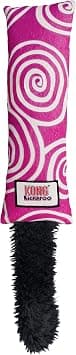
KONG Kickeroo Swirl
A long body is the whole design brief here, because it lets the cat grab with the front paws and rabbit-kick with the back ones. That bunny-kick motion is the end of the hunting sequence, and a toy that permits it discharges energy no ball on a track can reach.
We may earn a commission on this link. It never changes the ranking.
- Type
- Kicker plush with catnip
- Catnip
- North American premium catnip
- Length
- Long body for rear-paw kicking
- Supervision
- Safe unattended
What works
- Length is correct for the rabbit-kick motion, which most plush toys get wrong
- Catnip quality is noticeably better than supermarket toys
- Cheap enough to own several and rotate them
What to know
- Roughly a third of cats are genetically indifferent to catnip
- Plush eventually loses its stuffing to a determined cat
- Not machine washable in practice without losing shape
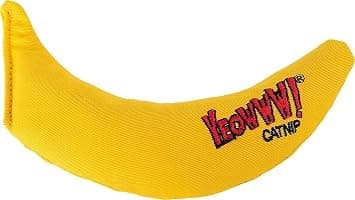
Yeowww! Chi-CAT-a Banana
Filled entirely with organically grown catnip leaf and blossom rather than the stalk and dust that pads out cheaper toys, and the difference in reaction is obvious within seconds. The cotton twill shell survives bunny-kicking far longer than plush.
We may earn a commission on this link. It never changes the ranking.
- Type
- Catnip toy
- Fill
- Organically grown catnip, no filler
- Shell
- Durable cotton twill
- Length
- 7 inches
What works
- Catnip potency is the real differentiator and it is very high here
- Twill shell outlasts plush by a wide margin
- Made in the USA with no synthetic scent added
What to know
- Useless for the cats that do not respond to catnip
- Potency fades over months, so store it sealed
- No visual or motion interest of its own
from $7.99
Price checked Aug 11, 2026
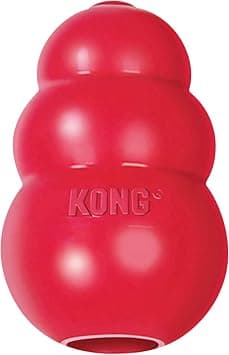
KONG Classic, small size, for cats
Sold for dogs, used by a lot of cat owners as a food-dispensing puzzle, and it works. Pack the small size with a smear of wet food or a few kibbles and the cat has to work the last stage of the sequence, which is the one indoor cats almost never get to perform.
We may earn a commission on this link. It never changes the ranking.
- Type
- Food-dispensing rubber toy
- Material
- Natural rubber
- Use for cats
- Small sizes only
- Supervision
- Safe unattended when undamaged
What works
- Turns feeding into foraging, which is the strongest form of cat enrichment
- Natural rubber survives everything a cat can do to it
- Dishwasher safe on the top rack
- Costs less than most purpose-built cat puzzles
What to know
- Sized and marketed for dogs, so buy small and check the fit
- Messy if you stuff it with wet food and leave it on a rug
- Some cats need several sessions to work out the mechanism
How they compare
| Toy | Type | Needs you | Safe unattended |
|---|---|---|---|
| Go Cat Da Bird | Wand | Yes | No, string |
| Catit Senses 2.0 Super Circuit | Track | No | Yes |
| KONG Kickeroo Swirl | Kicker plush | No | Yes |
| Yeowww! Chi-CAT-a Banana | Catnip | No | Yes |
| KONG Classic small | Food puzzle | No | Yes |
Who each one is wrong for
The wand is wrong as your only toy if you travel, work long days, or are honest with yourself about not playing daily. It is excellent and it is entirely dependent on you.
The catnip toys are wrong for roughly a third of cats. Catnip response is inherited, it does not appear until around six months, and no amount of quality fixes a cat that lacks the gene. If yours ignores catnip, try silver vine instead before concluding the cat does not play.
The track toy is wrong for a cat that has never seen one and is left to discover it alone. Sit on the floor and move the ball with a finger for two minutes. Most cats take it from there.
Playing so it actually works
Two sessions a day of ten minutes beats one of thirty. Move the toy away from the cat and into cover rather than at the cat. Pause often, because a stalk needs something to stalk. Let the cat catch the target several times during the session and definitively at the end, then feed. The hunt-catch-eat pattern is what turns play into a settled cat rather than an overstimulated one.
If your cat wakes you at four in the morning, move the biggest play session to just before your bedtime and feed after it. That is not a training trick, it is just the sequence, run at the hour you would rather the cat ran it. Owners who make that one change report the night waking dropping away inside a fortnight far more often than owners who try to ignore the cat, and ignoring a hungry hunting cat is a strategy with a poor record.
Older cats need the same sequence at a lower intensity rather than no sequence at all. Keep the wand low and slow, shorten the sessions to five minutes, and watch for a cat that wants to play but stops early, because reluctance to jump is one of the first signs of arthritis in cats and it is very easy to read as laziness.
Questions people actually ask
How much play does an indoor cat need?
Two structured sessions a day of around ten to fifteen minutes each, plus solo toys available in between. Young cats and single cats in small flats need more than that, and will tell you by using your ankles.
Are laser pointers bad for cats?
They are not harmful to use if you finish properly. The problem is that a dot cannot be caught, so the hunting sequence never completes. Land the dot on a physical toy at the end of the session and let the cat catch that instead.
Why does my cat ignore new toys?
Usually novelty fatigue or a movement pattern that does not read as prey. Rotate toys weekly rather than leaving everything out, and try a wand before concluding the cat does not play.
Is catnip safe?
Yes, it is non-addictive and self-limiting, and cats stop responding after about ten minutes regardless of how much is available. The response is inherited and roughly a third of cats do not have it.
Do cats need toys if there are two cats?
Yes. Cats that play together are wrestling, not hunting, and the hunting drive is a separate need. Two cats in a house with no prey-shaped outlet will usually find one, and it is normally your furniture.
Sources
As an Amazon Associate we earn from qualifying purchases. We earn a commission on some links, at no extra cost to you. It never changes which products we recommend or the order they appear in. Full disclosure

Who wrote this
Tess Lindqvist
Writer, cat products and everyday health
Tess Lindqvist writes the cat side of PetGearSearch, plus the health-adjacent categories where a label makes a claim the evidence has to back. The question asked of every product is the one owners actually ask at 3am: will the animal use it, and does it do the thing the box says.
The standard
How this guide was built
- The full product specification, ingredient panel or material spec, read end to end rather than summarised from a retail listing.
- The veterinary and regulatory guidance that applies to the category, cited by name and linked — AAFCO nutrient profiles, WSAVA manufacturer guidelines, the VOHC accepted-product list.
- Aggregated owner reviews at volume across retailers, read for the pattern rather than the anecdote, with deliberate attention to the one-star reports where the failure modes live.
- Every price checked against the live listing on the date printed beside it.