Best Beds for Dogs and Cats
Orthopaedic foam, a donut bed and a cat tree, judged on support that lasts, covers that survive washing, and who each one is wrong for.
By Marin Okafor, editor, dog gear and nutrition labels
Published Jul 30, 2026 · reviewed Sep 6, 2026 · 11 min read
- Beds & Furniture
- 3 products compared

In this guide
A pet bed has one job, which is to keep the animal off the floor and to keep doing it after two years. Almost all of them fail at the second part. Polyester fill compresses into a mat within months, cheap foam takes a permanent dent in the shape of the dog, and at that point the bed is a rug with edges. The animal is now sleeping on the floor with extra steps, and because the change is gradual nobody notices.
That single failure mode is what separates the beds worth buying from the rest, and it is why foam density, ILD and total thickness matter more than the photograph on the listing. A manufacturer prepared to write down what the foam will still be doing in seven years is telling you something specific. A listing that says orthopaedic and shows a golden retriever is telling you nothing at all, because the word orthopaedic has no legal definition in this category and appears on beds stuffed with shredded offcuts.
The three below cover a support bed that a dog and a cat can share, a comfort bed for an anxious sleeper or a cat that wants to burrow, and a cat tree for a cat that wants height in a house that also has a dog. The first two are used by both species, which is the normal case in a house with both and almost never how these products are sold. For the cat tree, stability and post length decide more than the price does, and where the thing stands decides more than either.
Two well-known beds are missing here on purpose: the Big Barker 7-inch orthopaedic bed and the K&H Ortho Bolster Sleeper. In September 2026 their Amazon listings, and two alternate listings for each, showed no main Add to Cart price for a new one, so there is no new unit we can point you to. The cat tree below is the standard Vesper High Base rather than the Giant, because the Giant's listing is unavailable and the standard High Base is in stock. A recommendation that leads to a page you cannot buy from is not a recommendation.
What decides whether a bed lasts
Foam matters more than thickness. A four-inch slab of low-density foam supports a large dog worse than three inches of high-density foam, and it fails faster. The number to look for is a stated density or a no-flatten warranty with a percentage in it. Very few brands publish either, which is itself informative.
The cover has to come off and go in the machine. Not a wipe-clean surface, not a removable top panel, a full zip-off cover that survives repeated hot washes. Every bed in a real house eventually meets mud, a wet dog, or an accident from a senior animal, and a bed you cannot wash is a bed you will throw away.
Bolsters are a preference, not an upgrade. Dogs that curl and animals that like to rest their head prefer them. Dogs that sprawl, and large dogs in warm rooms, use flat beds and hang off bolstered ones. Watch how your animal sleeps on the sofa before you choose.
Cats want height, warmth and a view. A cat bed on the floor in the middle of a room gets ignored while the cat sleeps on a radiator shelf. That is not fussiness, it is a small predator choosing a defensible position with a heat source. Buy for that instead of against it.
Where the bed goes matters as much as which bed. For a dog that currently sleeps on your mattress, a bed of its own on the bedroom floor is the arrangement the sleep studies on sharing a bed with a pet support most directly.
The picks
$50.96
Price checked Sep 6, 2026
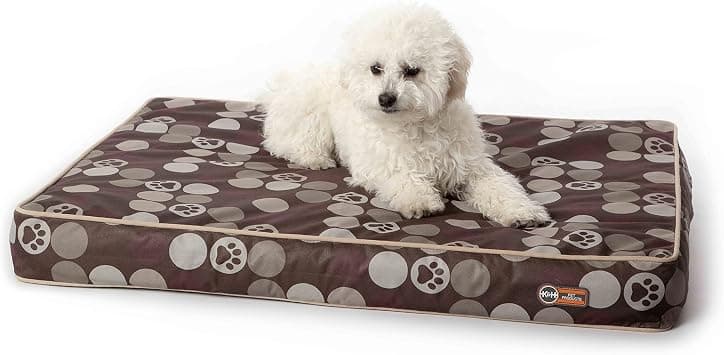
K&H Superior Orthopedic Indoor Outdoor Bed
The pick for a household trying to buy one bed rather than two. It is low enough for an arthritic animal of either species to walk onto rather than climb, the surface takes indoor and outdoor use, and in practice a cat colonises one end of it within a week. The listing linked here is the Small, 27 by 36 by 4 inches in brown with a paw print; larger sizes are separate variants on the same page, and the price above is for the Small.
We may earn a commission on this link. It never changes the ranking.
- Construction
- Orthopaedic foam
- Use
- Indoor or outdoor
- Entry
- Low profile, no climbing required
- Cover
- Removable and washable
- Linked size
- Small, 27 x 36 x 4 inches (listing title)
What works
- Low entry suits senior animals of both species
- Tolerates outdoor and porch use
- Foam support well ahead of fibre-filled beds at similar prices
- Large sizes are big enough to share
What to know
- Plain looking, with none of the styling of the premium beds
- Outdoor-capable fabric is less soft than an indoor plush cover
- Four inches of foam is a mid-range bed, not a giant-breed joint bed
$47.49
Price checked Sep 6, 2026
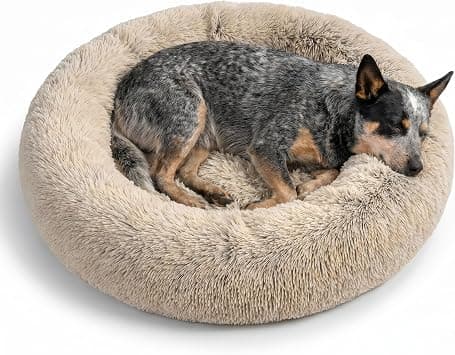
Best Friends by Sheri Original Calming Donut Dog Bed
The bed both species fight over. The raised rim gives a sense of enclosure that settles anxious dogs and suits cats almost perfectly. It is a comfort bed rather than a support bed, and it should not be asked to be both. The listing linked here is the Medium in taupe, 30 by 30 inches with a 23-inch sleeping surface, rated by the maker for dogs up to 45 lb.
We may earn a commission on this link. It never changes the ranking.
- Shape
- Round with raised-edge bolsters
- Fill
- High-loft polyfill, long shag faux fur
- Washing
- Removable cover, machine washable; water- and dirt-resistant base
- Size linked
- Medium, 30 x 30 x 7 inches, 23-inch sleeping surface, dogs up to 45 lb
What works
- Enclosure genuinely settles anxious animals
- Cats take to it as readily as dogs, which is unusual
- Cover zips off for the machine and the base resists water and dirt
- Other sizes and colours are variants of the same listing
What to know
- Polyfill compresses over time and will not support a heavy dog
- Shag pile collects hair and needs frequent washing
- Not the right bed for a dog with diagnosed joint disease
- The 23-inch sleeping surface is a lot smaller than the 30-inch outer measurement suggests
$124.99
Price checked Sep 6, 2026
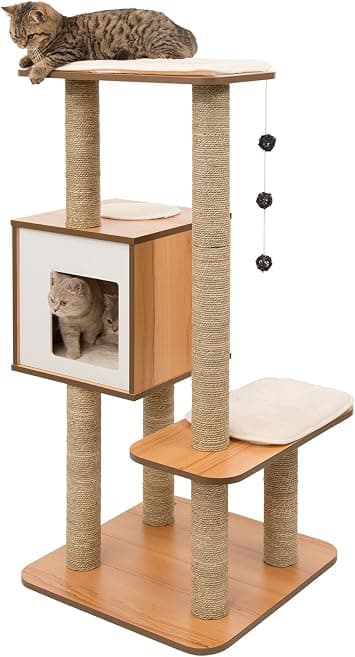
Catit Vesper High Base
Height is the point. A tall, stable cat tree gives a cat somewhere the dog cannot follow, which lowers tension in a mixed household more effectively than any behavioural trick, and the engineered-wood build is the rare cat furniture that does not look like cat furniture. This is the standard High Base, model 52045, which stands just under four feet on a 22-inch square base. The taller Giant version is listed as unavailable.
We may earn a commission on this link. It never changes the ranking.
- Dimensions
- 22.1 x 22.1 x 47.9 inches, 40.5 lb (listing)
- Material
- Engineered wood
- Format
- Cube with multiple exits, perches, scratching posts
- Cushions
- Memory foam cat bed cushions
- Use
- Indoor
What works
- Gives a cat vertical escape space, which matters enormously with a dog in the house
- Hard surfaces do not hold hair the way carpeted trees do
- A 40 lb tree on a 22-inch base is stable enough for a confident jumper
- Cube gives a nervous cat a place to hide with more than one way out
What to know
- Assembly takes time and the instructions are terse
- Heavy and awkward once built
- Under four feet tall, so a very athletic cat will still want a shelf above it
- Hard surfaces need the cushions in place for cats that want softness
How they compare
| Bed | Support type | Species | Best for |
|---|---|---|---|
| K&H Superior Orthopedic | Orthopaedic foam | Dog and cat | One support bed for both |
| Best Friends by Sheri Donut | Polyfill, raised rim | Dog and cat | Anxious sleepers |
| Catit Vesper High Base | Furniture, not a bed | Cat | Vertical space in a mixed home |
Who each one is wrong for
The K&H is wrong for a giant breed with diagnosed hip or elbow disease. Four inches of foam is a mid-range support bed, and a 100 lb dog with bad joints needs a thicker, denser slab from a maker that publishes a no-flatten warranty. Read what makes a dog bed orthopaedic before you spend on that class of bed, because the word on the listing is not the evidence.
The donut bed is wrong for a large dog with diagnosed arthritis or hip dysplasia. Polyfill compresses, and a dog that needs support will bottom out on it inside a few months. Buy it for comfort and buy foam for support, and if the animal needs both, buy both.
The cat tree is wrong for a household that will not anchor it. A 40 lb tree on a hard floor with a heavy cat launching off the top is a tipping risk, and every one of these should be against a wall.
Any shared bed is wrong if the animals are not comfortable with each other. A cat cornered on a bed by a dog that wants the same bed is a fight waiting to happen. Separate beds in separate rooms, plus vertical escape space for the cat, is the arrangement that keeps the peace.
Sizing, and the mistake almost everybody makes
Measure the animal nose to tail base while it is lying stretched out, then add six inches for a dog and four for a cat. Then check whether the size you chose measures the outside of the bolster or the inside of the sleeping surface, because manufacturers do both and the difference can be a third of the usable area. The donut above is the textbook case: 30 inches outside, 23 inches of sleeping surface. A bolstered bed sized by its external dimensions is normally a size too small in practice.
For an older animal, height matters as much as area. A bed with a thick rim is a step up, and a dog with weak hind legs will start sleeping on the floor beside it rather than tell you that the step is too much. Low-entry beds and a non-slip surface underneath solve more senior sleep problems than an upgrade in foam does, and the same floor-grip problem follows the dog well past the bed itself: ramps and traction runners placed where a dog actually walks do more for a stiff dog's confidence than the bed alone ever will.
Warmth is a separate decision from support. A dog that sleeps in a cold garage needs an outdoor-rated electric pad, and a dog in a heated house with a good bed may need nothing more than an insert. The difference between those and a plug-free reflective pad is set out in our guide to heated and self-warming dog beds.
Questions people actually ask
How do I know if a bed is genuinely orthopaedic?
Look for a stated foam density or a warranty that quantifies retained support over a period of years. The word itself is unregulated in this category and appears on beds filled with shredded foam offcuts.
How often should a pet bed be washed?
Every one to two weeks for the cover, more often for an animal with allergies or skin problems. Wash on hot, and check whether the inner foam has its own waterproof liner before it meets a wet dog.
Will a cat use a dog bed?
Frequently, and often in preference to the cat bed you bought. Cats choose by warmth, enclosure and vantage point rather than by label. A large dog bed in a sunny corner is very likely to be taken.
Do heated beds help older pets?
Warmth does help arthritic joints, and low-wattage pet-safe heated beds are widely used for senior cats in particular. Use products designed for pets with a thermostat, never a human heating pad, and give the animal room to move off the heat.
My dog destroys every bed. What now?
Chewing a bed is usually boredom or anxiety rather than a preference for foam. Address the cause, use a chew-resistant cordura-style cover in the meantime, and never leave a destroyed bed in place, because ingested foam and fibre cause obstructions.
Sources
- Cornell Riney Canine Health Center on osteoarthritis in dogs
- Cornell Feline Health Center on arthritis and degenerative joint disease in cats
- AAFP and ISFM feline environmental needs guidelines on vertical space and resting places
- K&H Superior Orthopedic Indoor Outdoor Bed
- Best Friends by Sheri Original Calming Donut Cuddler
- Catit Vesper High Base
As an Amazon Associate we earn from qualifying purchases. We earn a commission on some links, at no extra cost to you. It never changes which products we recommend or the order they appear in. Full disclosure

Who wrote this
Marin Okafor
Editor, dog gear and nutrition labels
Marin Okafor edits PetGearSearch and writes the dog side of it: food, beds, crates, carriers, grooming tools, and the pet insurance policies that pay for the rest. The ingredient panel and the AAFCO statement get read before a single review does, because that back-of-bag paragraph is where two apparently identical foods stop being identical.
The standard
How this guide was built
- The full product specification, ingredient panel or material spec, read end to end rather than summarised from a retail listing.
- The veterinary and regulatory guidance that applies to the category, cited by name and linked — AAFCO nutrient profiles, WSAVA manufacturer guidelines, the VOHC accepted-product list.
- Aggregated owner reviews at volume across retailers, read for the pattern rather than the anecdote, with deliberate attention to the one-star reports where the failure modes live.
- Every price checked against the live listing on the date printed beside it.