Best Joint Supplements for Senior Dogs
Four joint supplements worth the money and one worth skipping the hype on, judged on the ingredient doses, the published trials and what the label does not say.
By Tess Lindqvist, writer, cat products and everyday health
Published Jul 23, 2026 · reviewed Sep 5, 2026 · 9 min read
- Supplements & Health
- 4 products compared

In this guide
Joint supplements are the least regulated shelf in the pet aisle. They are sold as nutritional supplements rather than as drugs, which means nobody has to prove that a product works before selling it, and nobody has to prove that the tub contains what the label says. Independent testing of human and animal glucosamine products has repeatedly found tubs containing a fraction of the labelled amount, and a supplement at a quarter of the labelled dose is an expensive placebo.
The one industry seal that partly closes that gap is worth understanding before you buy anything here. That is the reason this guide is short and the reason it is heavily weighted toward two companies. Nutramax funds and publishes research on its own formulations, and the reason its products are the ones veterinarians name is not marketing spend but the fact that the specific ingredients in them have been studied at the doses actually used. That is a low bar. Almost nothing else in this category clears it.
The honest framing for the whole category is this: the strongest evidence in canine osteoarthritis is for weight management, controlled exercise, omega-3 fatty acids from marine oil at a dose most products do not reach, and prescription pain control. Supplements sit underneath all of that. A dog that is 15 percent overweight will get more relief from losing the weight than from anything in a tub, and a dog in real pain needs a vet and a prescription rather than a chew.
What to look for on the label
A named, studied ingredient at a stated dose. Glucosamine hydrochloride and sodium chondroitin sulfate should be listed in milligrams per tablet, with a feeding chart by body weight. If a product lists a proprietary blend without per-ingredient amounts, you cannot tell what you are buying.
Avocado soybean unsaponifiables, if you want the ingredient with the most canine-specific interest. ASU is what separates the Dasuquin line from ordinary glucosamine products, and it is the reason vets recommend one over the other.
Marine omega-3 at a therapeutic dose. EPA and DHA from fish oil have the best evidence base of anything sold over the counter for canine joints. Flaxseed is not a substitute, because dogs convert plant-source omega-3 to EPA very poorly.
A quality seal you can check. The National Animal Supplement Council seal on a tub means the company submits to facility audits and adverse event reporting. It is not proof of efficacy, but it is proof that somebody is watching.
Realistic timelines. Nothing here works in a week. Six to eight weeks at the loading dose is the point at which you decide whether it is doing anything, and the way to decide is a written note of what the dog could do before you started.
The picks
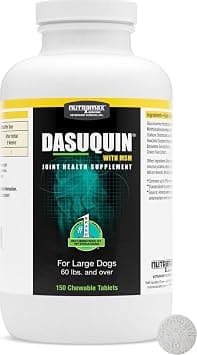
Dasuquin with MSM Chewable Tablets
The one to buy. Glucosamine hydrochloride and chondroitin sulfate in the specific researched forms, plus ASU, which is the ingredient the rest of the shelf does not have. It is the most commonly recommended joint supplement in veterinary practice, and unusually for this category that recommendation rests on published work rather than on sales reps.
We may earn a commission on this link. It never changes the ranking.
- Key ingredients
- Glucosamine HCl, chondroitin sulfate, ASU, MSM
- Formats
- Chewable tablets and soft chews
- Sizing
- Separate formulations by dog weight
- Loading period
- Typically four to six weeks
What works
- ASU inclusion is the meaningful difference from ordinary glucosamine products
- Researched ingredient forms at stated doses rather than a proprietary blend
- Weight-banded formulations rather than one size for every dog
- The default recommendation in a great many veterinary practices
What to know
- Among the most expensive options per day
- Tablet size is substantial for small dogs
- MSM version is unnecessary for some dogs, and the plain version costs less
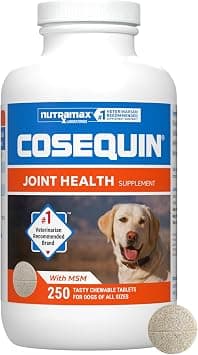
Cosequin Maximum Strength Plus MSM Chewable Tablets
The same manufacturer, the same researched glucosamine and chondroitin forms, without the ASU. It is the sensible entry point for a middle-aged dog with early stiffness rather than diagnosed arthritis, and it is materially cheaper per day than stepping straight to Dasuquin.
We may earn a commission on this link. It never changes the ranking.
- Key ingredients
- Glucosamine HCl, sodium chondroitin sulfate, MSM
- Formats
- Chewable tablets
- Sizing
- Dosing by body weight
- Quality
- NASC member manufacturer
What works
- Well established, widely stocked, and consistently manufactured
- Cheaper per day than the ASU formulations
- Good first step for early stiffness in a middle-aged dog
What to know
- No ASU, which is the ingredient with the most canine-specific research behind it
- MSM evidence in dogs is thinner than for the other components
- Chewable tablets are not accepted by every dog
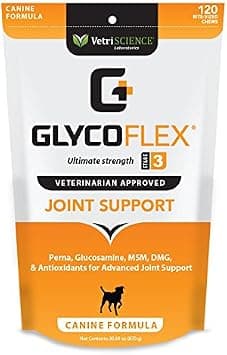
VetriScience GlycoFlex Stage 3
The maximum-strength tier, built around green-lipped mussel alongside glucosamine, MSM and DMG. It is the formulation most often reached for after orthopaedic surgery or for a dog with a heavy workload, and green-lipped mussel is one of the few other ingredients in this category with published canine work behind it.
We may earn a commission on this link. It never changes the ranking.
- Key ingredients
- Glucosamine, MSM, green-lipped mussel, DMG
- Tier
- Maximum strength, stage 3
- Format
- Bite-sized chews
- Use case
- Senior, working and post-surgical dogs
What works
- Green-lipped mussel adds a mechanism the glucosamine-only products do not have
- Chew format is accepted more readily than tablets
- Staged product line makes it easy to step up or down
What to know
- Shellfish-derived, so it is not for a dog with a shellfish sensitivity
- Costs more per day than the mid-tier products
- Chews add calories, which matters for the overweight dog who needs this most
from $32.97
Price checked Sep 5, 2026
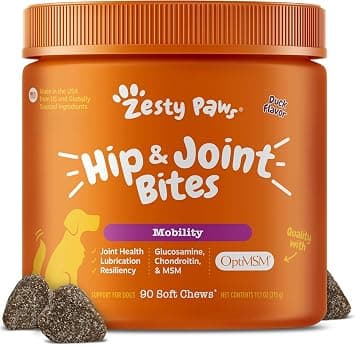
Zesty Paws Hip and Joint Mobility Bites
A soft chew with glucosamine, chondroitin and OptiMSM at a lower price than the veterinary brands, and the practical answer for a dog that spits out everything else. Treat it as a maintenance product for a comfortable dog rather than as a treatment for one that is limping.
We may earn a commission on this link. It never changes the ranking.
- Key ingredients
- Glucosamine HCl, chondroitin sulfate, OptiMSM
- Format
- Soft chews, duck flavour
- Count
- 90 chews per bag
- Quality
- NASC quality seal
What works
- Palatability is the strongest of anything here
- Cheaper per day than the veterinary-brand tablets
- NASC seal on the packaging
What to know
- Lower ingredient doses than the maximum-strength products
- Chews carry calories, which is a real consideration in an arthritic dog
- Marketing outruns the evidence base for the formulation
How they compare
| Product | Key ingredients | Format | Best for |
|---|---|---|---|
| Dasuquin with MSM | Glucosamine, chondroitin, ASU, MSM | Chewable tablet | Diagnosed arthritis |
| Cosequin Maximum Strength Plus MSM | Glucosamine, chondroitin, MSM | Chewable tablet | Early stiffness |
| GlycoFlex Stage 3 | Glucosamine, MSM, green-lipped mussel | Soft chew | Post-surgical, working dogs |
| Zesty Paws Mobility Bites | Glucosamine, chondroitin, OptiMSM | Soft chew | Fussy dogs, maintenance |
What to do before you buy any of them
Weigh the dog. Body condition is the single biggest modifiable factor in canine osteoarthritis, and the effect of getting a dog to a lean weight is larger than the effect of any supplement in this guide. A dog carrying an extra 15 percent is loading every arthritic joint with it on every step, all day.
Then look at the surface the dog lives on. Hard floors and slippery laminate make arthritic dogs tentative, and a set of runners along the routes the dog uses does more for confidence than a month of chews. Ramps instead of jumping into the car, and a bed the dog can walk onto rather than climb, belong in the same list.
Then ask the vet about pain control. Supplements are not analgesics. A dog that is stiff after a walk is a different animal from a dog that will not use the stairs, and the second one is in pain that has a prescription answer. Starting a supplement instead of getting that dog assessed costs the dog months.
Judging whether it worked
Write down three things the dog does now, before you start, with numbers. How many minutes into a walk it slows down. Whether it takes the stairs in one go. How long it takes to stand up from lying. Then run the loading dose for the full period on the label and check the same three things.
The reason for writing it down is that owner memory is unreliable and expectation is powerful. A supplement you paid for and gave every day for eight weeks will feel like it worked. Three specific observations from before you started are the only way to know.
Questions people actually ask
Do joint supplements actually work in dogs?
The evidence is mixed and much weaker than the marketing suggests. The strongest support is for marine omega-3 fatty acids, followed by the specific researched glucosamine, chondroitin and ASU combinations. Weight control and pain medication have far better evidence than any of them.
How long before I see a difference?
Six to eight weeks at the loading dose. Anything reported inside a fortnight is more likely to be the owner's expectation, or the weather, than the supplement.
Can I give my dog a human glucosamine supplement?
The active ingredients are similar, but human products may contain xylitol, which is severely toxic to dogs, and the dosing is not designed for canine body weight. Use a product made for dogs and check the ingredients for xylitol.
Is fish oil worth adding as well?
For most arthritic dogs, yes. Marine EPA and DHA have the best evidence in this category. Doses used therapeutically are higher than the label on a general-purpose supplement, so ask your vet for a number based on the dog's weight.
Should I start a supplement before my dog has any symptoms?
For a large breed with a family history of hip dysplasia, or a dog that has had orthopaedic surgery, many vets do start early. For a healthy young dog with no risk factors, the money is better spent on keeping the dog lean.
Sources
- Cornell Riney Canine Health Center on osteoarthritis in dogs
- National Animal Supplement Council quality seal programme
- FDA Center for Veterinary Medicine on animal supplements and label claims
- ASPCA Animal Poison Control on human medications that are toxic to pets
- Dasuquin with MSM Chewable Tablets
- Cosequin Maximum Strength Plus MSM
- VetriScience GlycoFlex Stage 3
- Zesty Paws Hip and Joint Mobility Bites
As an Amazon Associate we earn from qualifying purchases. We earn a commission on some links, at no extra cost to you. It never changes which products we recommend or the order they appear in. Full disclosure

Who wrote this
Tess Lindqvist
Writer, cat products and everyday health
Tess Lindqvist writes the cat side of PetGearSearch, plus the health-adjacent categories where a label makes a claim the evidence has to back. The question asked of every product is the one owners actually ask at 3am: will the animal use it, and does it do the thing the box says.
The standard
How this guide was built
- The full product specification, ingredient panel or material spec, read end to end rather than summarised from a retail listing.
- The veterinary and regulatory guidance that applies to the category, cited by name and linked — AAFCO nutrient profiles, WSAVA manufacturer guidelines, the VOHC accepted-product list.
- Aggregated owner reviews at volume across retailers, read for the pattern rather than the anecdote, with deliberate attention to the one-star reports where the failure modes live.
- Every price checked against the live listing on the date printed beside it.