Best Cat Litter for Odour and Tracking
Four picks judged on clumping strength, dust, tracking and the thing that decides everything: whether cats will actually use them.
By Tess Lindqvist, writer, cat products and everyday health
Published Jul 16, 2026 · reviewed Oct 10, 2026 · 9 min read
- Litter & Boxes
- 4 products compared
In this guide
Litter is the only pet product that has to satisfy two customers with opposite priorities. You want low dust, low tracking, low odour and a low price. The cat wants a fine, soft, unscented substrate that feels like the sandy soil its ancestors dug in, and cares about none of the rest. Where those two lists conflict, the cat wins, because a cat that dislikes the litter stops using the box, and a cat that stops using the box is a far bigger problem than a bag of litter you did not enjoy carrying.
That is the frame for everything below. The best-selling scented litters exist because humans buy them, not because cats prefer them. Research into cat substrate preference has consistently pointed the same way: fine-grained, unscented, clumping clay, at a depth of around three inches, in a box big enough to turn around in. Almost every litter recommendation that ignores that runs into the same wall eventually.
These four are the picks. Three are litters and one is the box, because at a certain point the honest answer to "how do I deal with the smell" is that the smell is a scooping frequency problem rather than a litter problem, and how many boxes you have and where they sit does more work than any bag on this list.
What actually decides which litter is better
Clump integrity is the whole game. A litter that forms a hard clump you can lift intact removes the urine completely. A litter that crumbles leaves half of it behind to bake into the bottom of the box, which is where the ammonia smell you are fighting actually comes from. Almost every complaint about odour in a well-scooped box traces back to weak clumping.
Dust is a respiratory question for both of you. Sodium bentonite litters vary enormously in dust, and the difference shows up as a visible cloud when you pour. Cats with asthma, and there are many undiagnosed ones, do measurably worse with dusty litter.
Tracking is granule size and shape. Fine granules clump better and track further. That trade-off is real and unavoidable, and the fix is a deep-pile mat outside the box rather than a coarser litter the cat likes less.
Scent is for you and against the cat. Cats have an olfactory system many times more sensitive than ours. A litter that smells pleasantly of lavender at your nose height is overwhelming at theirs. If you buy one scented product in this category, make it the box deodoriser rather than the litter itself.
The picks
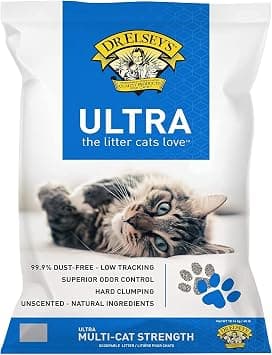
Dr. Elsey's Ultra Unscented Clumping Clay
The litter to buy unless you have a specific reason not to. Hard clumps, very low dust for a clay litter, unscented, fine grain, and formulated by a veterinarian whose entire clinical interest was cats that stop using the box. If you are switching a cat that has had litter box problems, start here.
We may earn a commission on this link. It never changes the ranking.
- Type
- Sodium bentonite clay, clumping
- Scent
- Unscented
- Dust
- 99 percent dust free
- Grain
- Fine, cat-preferred texture
What works
- Clumps hard enough to lift intact every time, which is what actually controls odour
- Unscented and fine-grained, which is what substrate preference research points to
- Works in sifting and mechanical boxes
- Widely available in large bags
What to know
- Heavy, and the 40lb bag is genuinely awkward
- Fine grain means it tracks, so budget for a good mat
- Clay is neither flushable nor renewable
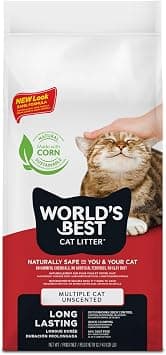
World's Best Cat Litter, Multiple Cat Clumping Formula
Whole-kernel corn rather than clay, which makes the bag roughly half the weight for the same coverage and cuts dust to almost nothing. It clumps genuinely well for a plant litter, which most corn and wheat products do not, and it is the pick if carrying 40lb of clay up a staircase is the part you dread.
We may earn a commission on this link. It never changes the ranking.
- Type
- Whole-kernel corn, clumping
- Scent
- Unscented option available
- Weight
- Roughly half the weight of clay for equal coverage
- Flushable
- Yes, where local rules permit
What works
- Much lighter to buy and carry than clay
- Very low dust, which suits asthmatic cats and asthmatic owners
- Clumps hard for a plant-based litter
- Flushable in small amounts where permitted
What to know
- Costs more per pound than clay
- Corn substrate can attract pantry moths if stored badly in a warm house
- A minority of cats reject the texture on switching
from $23.99
Price checked Oct 10, 2026
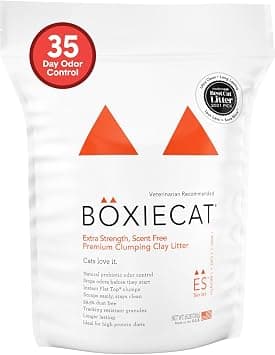
Boxie Extra Strength Odor Control Clumping Clay
The one to buy when the box is in a room you also live in. Boxie's approach is to attack the bacteria that generate odour rather than to cover the result with fragrance, and in a two or three cat household that is a materially different experience from a standard clay litter.
We may earn a commission on this link. It never changes the ranking.
- Type
- Sodium bentonite clay, clumping
- Odour approach
- Targets odour-causing bacteria
- Scent
- Unscented
- Dust
- Low dust formulation
What works
- Noticeably better in small spaces and multi-cat homes
- Unscented, so the odour control is not just perfume
- Hard clumping and low dust
- Consistent granule size
What to know
- Premium price per pound
- Direct and online availability rather than every supermarket
- Still a heavy clay litter to carry
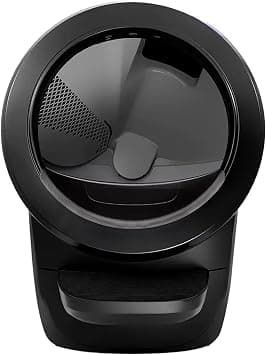
Litter-Robot 4
Expensive, and the only product here that solves the actual problem rather than mitigating it. Waste is separated within minutes of use and sealed in a drawer, which means the ammonia never forms. The weight sensor also logs each cat's visits, which is a genuine early-warning signal for urinary and kidney problems.
We may earn a commission on this link. It never changes the ranking.
- Type
- Automatic self-cleaning box
- Litter
- Uses standard clumping clay
- Monitoring
- Per-cat weight and visit logging
- Capacity
- Suits multi-cat households
What works
- Odour control is structural rather than chemical, because waste is removed within minutes
- Visit and weight tracking catches urinary changes early, which matters enormously in cats
- Handles multiple cats without daily intervention
- Uses ordinary clumping clay rather than proprietary refills
What to know
- Costs many times what a year of litter costs
- Some cats need weeks of patient introduction, and a few never accept it
- Mechanical parts eventually need service, and the drawer still needs emptying
How they compare
| Litter | Base | Dust | Best for |
|---|---|---|---|
| Dr. Elsey's Ultra | Clay | Very low | Almost every household |
| World's Best Multiple Cat | Corn | Very low | Lighter bags, asthma |
| Boxie Extra Strength | Clay | Low | Multi-cat and small flats |
| Litter-Robot 4 | Uses clay | Depends on litter | Never scooping again |
Who each one is wrong for
Corn litter is wrong for a house with a pantry moth history or a hot garage, because the substrate is food. Store it sealed and cool and the problem does not arise.
The automatic box is wrong for a nervous cat, a kitten under four months, or a household that cannot leave the old box in place for the several weeks the transition can take. It is also wrong as a way to scoop less in a house where the real issue is too few boxes.
Any scented litter is wrong for a cat that has recently stopped using the box. When that happens, the order of operations is vet first to rule out a urinary tract problem or crystals, then box count and placement, then substrate. Changing the litter first wastes the diagnostic window.
The setup that fixes most litter box problems
One box per cat plus one spare, in different rooms rather than lined up in the same one. Uncovered, large, and at least one and a half times the length of the cat. Three inches of litter, unscented. Scoop twice a day and change the whole box on a schedule rather than when it starts to smell. Wash with unscented soap and water, never with anything containing ammonia, which reads to a cat as another cat's urine.
Whether that box is covered or open matters less than most people think. Location does more work than product choice. A box in a corner where the cat can see the room, away from the food bowls and away from the washing machine that starts without warning, will be used by cats that reject the same box in a cupboard. If you have a house with stairs and an older cat, put a box on every floor, because arthritis is very common in senior cats and very rarely diagnosed, and a painful trip downstairs is a reason to go on the rug instead.
Questions people actually ask
How often should I change the whole litter box?
Scoop at least twice daily. With a good clumping litter and daily scooping, a full change every two to four weeks is reasonable for one cat. Change more often with multiple cats, and always wash the box itself when you do.
Is clumping litter safe for kittens?
The concern is ingestion in very young kittens who mouth everything. Most vets are comfortable with clumping clay from around eight to ten weeks, and non-clumping alternatives exist for younger kittens. Ask your vet if you are unsure.
Why has my cat suddenly stopped using the box?
See a vet first. Urinary tract disease, crystals, arthritis and cognitive decline all present this way. Once medical causes are excluded, work through box count, box size, location, cleanliness and substrate in that order.
Does scented litter help with odour?
It masks odour for you and adds an aversive smell for the cat. Hard clumping plus frequent scooping controls odour at the source. If you want a scent product, use a box deodoriser under the litter rather than a fragranced litter.
Are natural litters as good as clay?
Corn and wheat litters have come a long way and the best of them clump well, with much lower weight and dust. Pine and paper pellets do not clump and suit specific situations, such as post-surgical recovery, more than general use.
Sources
- Cornell Feline Health Center on feline house soiling and litter box management
- AAFP and ISFM guidelines on feline environmental needs
- Cornell Feline Health Center on feline lower urinary tract disease
- Dr. Elsey's Ultra Clumping Clay Litter
- World's Best Cat Litter Multiple Cat Clumping Formula
- Boxie Extra Strength Odor Control Clumping Clay Litter
- Litter-Robot 4
As an Amazon Associate we earn from qualifying purchases. We earn a commission on some links, at no extra cost to you. It never changes which products we recommend or the order they appear in. Full disclosure

Who wrote this
Tess Lindqvist
Writer, cat products and everyday health
Tess Lindqvist writes the cat side of PetGearSearch, plus the health-adjacent categories where a label makes a claim the evidence has to back. The question asked of every product is the one owners actually ask at 3am: will the animal use it, and does it do the thing the box says.
The standard
How this guide was built
- The full product specification, ingredient panel or material spec, read end to end rather than summarised from a retail listing.
- The veterinary and regulatory guidance that applies to the category, cited by name and linked — AAFCO nutrient profiles, WSAVA manufacturer guidelines, the VOHC accepted-product list.
- Aggregated owner reviews at volume across retailers, read for the pattern rather than the anecdote, with deliberate attention to the one-star reports where the failure modes live.
- Every price checked against the live listing on the date printed beside it.